The record chase and the kit statistic
Kylian Mbappé is two goals from Lionel Messi’s World Cup scoring record, but a smaller statistical quirk gives France’s match against Norway another subplot: he has never scored at the tournament in an away shirt. The record chase is the headline, and for good reason. Yet the kit detail offers a useful reminder that even a simple career statistic can be shaped by circumstances beyond a player’s finishing.
Mbappé reached 16 World Cup goals with a brace against Iraq, drawing level with Germany’s Miroslav Klose. Messi leads the all-time list with 18 after scoring twice against Austria on Monday. At 27, Mbappé has time to challenge that mark at this tournament or a future one, though he’s said he doesn’t intend to play until 40, as Messi and Cristiano Ronaldo have.
His scoring rate is already exceptional. Mbappé has 16 goals in 16 World Cup appearances, while Messi needed 28 matches to reach 18, a record number of appearances in the competition. Those figures suggest Mbappé has made an immediate impact whenever he’s played, but they don’t establish how many goals either player would have scored under the other’s circumstances. A rate is a sharp comparison, not a complete account of a career.
A rare chance in France’s away shirt
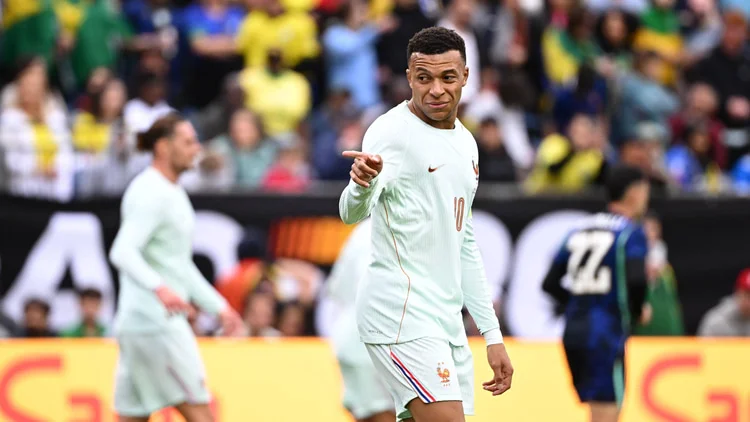
Every one of Mbappé’s World Cup goals has come while France wore its home kit. Since his tournament debut in 2018, Les Bleus have played in their away strip only twice: a 0-0 draw with Denmark in the group stage and a quarter-final win over Uruguay, when Raphaël Varane and Antoine Griezmann scored. In other words, the absence of an away-shirt goal reflects a small number of chances to score in that kit as much as it reflects Mbappé’s own output.
France didn’t wear its away kit at the 2022 tournament in Qatar, and hasn’t done so yet in 2026. That changes against Norway, when the team is set to debut a light green strip inspired by the Statue of Liberty. If Mbappé scores, he’ll break a streak that has lasted through all 16 of his World Cup goals. It would be a neat addition to the record, though the kit itself won’t explain how or why the goal arrived.
Here’s the thing: football records often make coincidences look more meaningful than they are. A player can go years without scoring in a particular shirt because the team rarely wears it, because the right opportunity never comes, or simply because goals are scarce in individual matches. This is more significant than it looks as a footnote to the record chase, but it shouldn’t be mistaken for evidence that one kit suits Mbappé better than another.
Kit history puts the quirk in context
The pattern sounds striking, but it’s partly a product of how rarely France must change kits. Few national teams share the same traditional colours. Japan, Scotland and Italy would be the clearest potential clashes for France; Italy hasn’t appeared at a World Cup since Mbappé’s debut. Haiti and Curaçao could also have created a colour conflict at this tournament.
Brazil faces a similar situation: relatively few teams traditionally wear yellow, including Australia, Colombia, Ecuador and Sweden. France’s away strip against Norway is intended to make the teams easy to distinguish. Norway’s kit is mainly red, with some blue, so France’s home shirt could likely have worked. FIFA’s stricter kit-selection rules, however, mean teams are increasingly asked to switch strips even without an obvious clash.
That distinction matters. A team’s away kit isn’t necessarily reserved for the most obvious colour conflicts; it can be chosen under rules that require clearer separation between the teams. Similar kit decisions are often practical, aimed at making players easier to distinguish on the pitch and on screen. And yet, for supporters tracking an individual record, that routine choice can create an unusual setting for a milestone.
How the other scoring records compare
Other leading scorers show that Mbappé’s record is unusual but not unprecedented. Ronaldo scored all 15 of his World Cup goals in Brazil’s home shirt, and Just Fontaine’s record 13 goals at the 1958 tournament all came in France’s home colours. Messi has scored all but his first World Cup goal in Argentina’s famous striped shirt; his 2006 strike against Serbia and Montenegro made him his country’s youngest scorer at the time.
Klose scored all but three of his 16 goals in Germany’s traditional home colours, while Pelé scored twice in Brazil’s away kit among his 12 World Cup goals. The comparison shows how uneven the pattern can be: some great scorers have done nearly all their work in a home strip, while others have scored in both. It doesn’t point to a common explanation, and the totals alone can’t tell us whether kit choice had any bearing on performance.
What the Norway match can add
The match against Norway gives Mbappé a chance to add a new detail to a scoring record already keeping pace with the tournament’s greatest forwards. If you’re following the record chase, the central question remains how close he can get to Messi’s 18 goals; the away-kit statistic is a secondary marker, interesting because the opportunity has been so rare.
That said, the significance of the match will depend on what happens in front of goal, not on the colour of France’s shirt. A goal would end the drought and extend Mbappé’s total, while a quiet outing would leave the quirk intact without changing the larger comparison. One more line in the record book. The match offers a fresh setting, not a forecast of what comes next.